With 96%, Santiago del Estero is the province that increased its GGP the most
This is indicated by the report carried out by the Economic Commission for Latin America and the Caribbean (ECLAC), the United Nations agency that ranks the province as the district with the greatest growth in its Gross Geographic Product (GGP) over the past 17 years
The ECLAC study points out that, from 2004 to 2021, Santiago del Estero is the province
that increased its Gross Geographic Product the most. It details the evolution of the
products and the GDP (Gross Domestic Product). In other words, during these years—
which coincide with the beginning of Gerardo Zamora’s first administration—Santiago
grew by 96%, triple that of the Autonomous City of Buenos Aires.
Without a doubt, this demonstrates not only a strong development path but also a
steady growth trend.
To determine this metric, a methodology was applied that breaks down the national
gross value added at constant 2004 prices, using physical volume indices developed
for each jurisdiction. Using this method, calculations and information sources were
applied to 52 branches of economic activity.
Back in 2017, the National Institute of Statistics and Censuses (INDEC) published an
estimate of the Gross Geographic Product for the 23 provinces and the Autonomous
City of Buenos Aires corresponding to 2004, using that year as the baseline. To address
the lack of this essential information—necessary for decision-making by provincial and
national authorities as well as the academic world—ECLAC, the Ministry of Economy,
and the Center for Production Studies developed a methodology that allows the
breakdown of the Gross Value Added (GVA) at constant 2004 prices for all 24
jurisdictions.
Therefore, the final result of this estimate provides a homogeneous and consistent
series of GVA distribution at basic prices for all 24 jurisdictions since 2004.
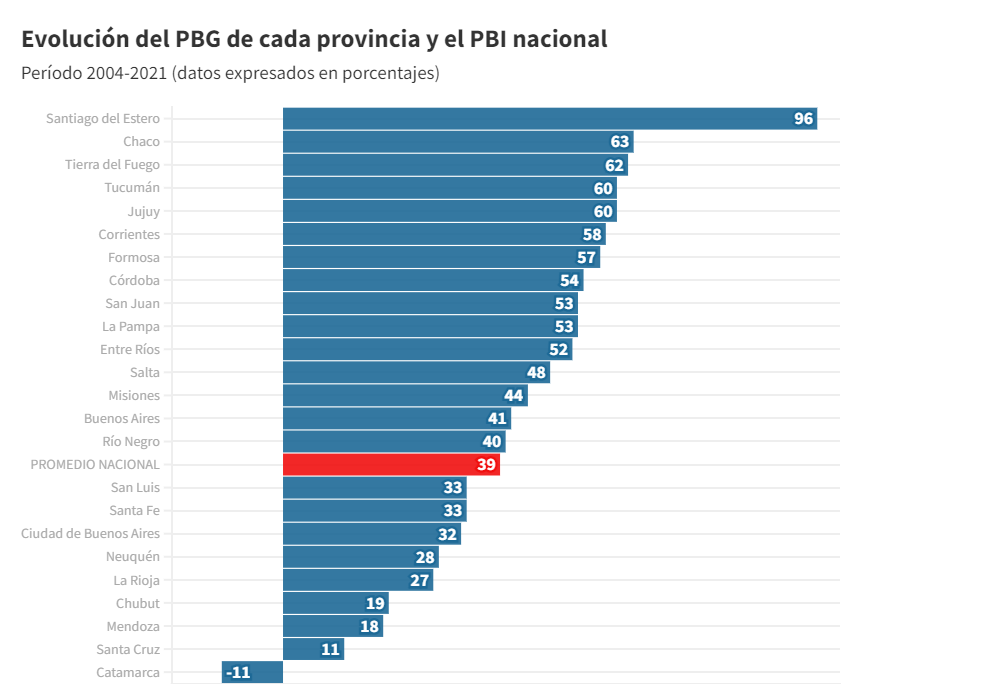
According to the chart on the evolution of the Gross Geographic Product, Santiago is
ranked first with 96%. It is followed by Chaco with 63%; Tierra del Fuego with 62%;
Tucumán with 60%; and Jujuy also with 60%.
They are followed by Corrientes with 58%, Formosa with 57%; Córdoba with 54%; San
Juan and La Pampa with 53%; and Entre Ríos with 52%. Meanwhile, the national
average stands at 39%, meaning that Santiago exceeds it by more than double, and
triples Buenos Aires City (32%).
Regarding the report, the Governor of the Province, Gerardo Zamora, commented on his
social media, highlighting:
“There is a reason why we are ranked as the 6th Argentine province with a positive trade
balance in dollars in the last year. While there is still much to be done—and we will
continue working toward that goal—to reverse longstanding asymmetries, a truly
federal country will allow us to become a stronger nation. We are no longer the province
many remember, and about which some, from the Buenos Aires centralism, speak
without knowing.”